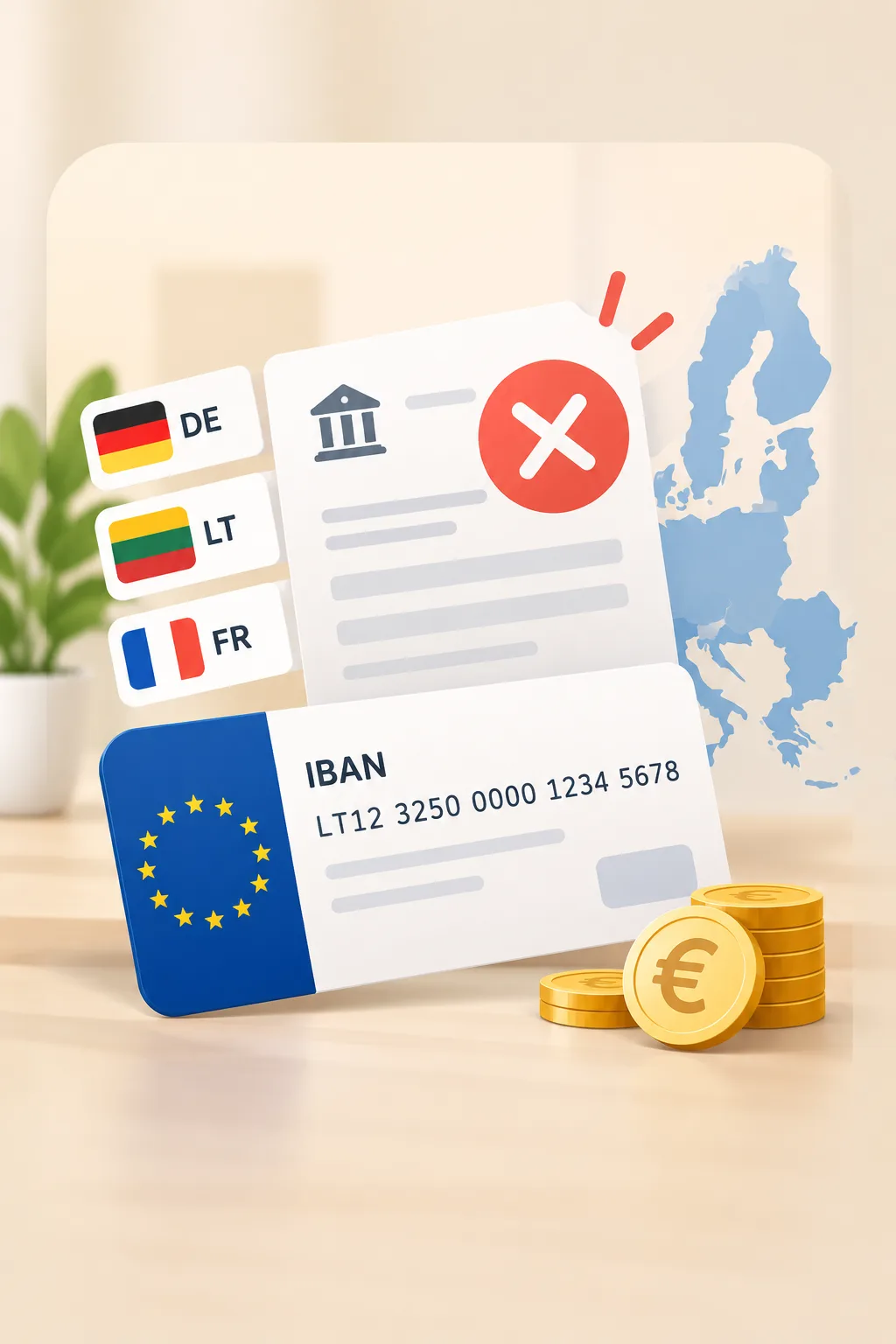
You want your salary paid into your European bank account, or you want to pay for a contract by direct debit, but your IBAN is not accepted? Perhaps your employer insists on a German account number, or an online form only accepts IBANs starting with DE. This may be what is known as IBAN discrimination. In the European Union and the European Economic Area, nobody may generally dictate in which country your account must be held for SEPA payments in euro. So you do not have to open a German bank account for that reason alone. Here you can find out which rules apply and what to do if your IBAN is rejected.
An IBAN from another EU or EEA country generally may not be rejected for SEPA credit transfers and SEPA direct debits in euro solely because of the country where the account is held. This is set out in Article 9 of Regulation (EU) No 260/2012. One condition, among others, is that the account can be reached for the type of payment concerned. So not every rejection is unlawful.
What is IBAN discrimination?
IBAN discrimination occurs when someone making or receiving a SEPA payment demands an account from a particular country, or rejects an account from another EU or EEA country solely because of that country, even though the legal requirements are met. For example, a German employer may not simply refuse to pay a salary into a reachable Lithuanian account because the IBAN starts with LT instead of DE. The same generally applies to companies that offer SEPA direct debits. A gym or mobile phone provider may not insist on a German IBAN for that reason alone. What matters is not the letters your IBAN starts with, but whether the account meets the requirements for the payment concerned.
| – | Generally allowed | Generally not allowed |
|---|---|---|
| Payment | The account cannot be reached for this type of payment | An EU or EEA IBAN is rejected only because of the country |
| Direct debit | The provider does not offer direct debit at all | The provider only accepts German IBANs |
| Salary | The payment fails for an objective reason | The employer insists on a DE IBAN only |
| Online form | The IBAN contains a typing error | The form only accepts German IBANs |
Does this apply everywhere SEPA is used?
Not automatically. You need to distinguish between three areas. European Union (EU): Regulation (EU) No 260/2012 applies directly in all EU member states. European Economic Area (EEA): The EEA also includes Iceland, Liechtenstein and Norway. The SEPA Regulation applies there as well, so a euro IBAN from these countries is also protected. SEPA area: It is larger than the EU and the EEA. Switzerland, the United Kingdom, Monaco and San Marino, for example, also take part in SEPA payments. Taking part does not mean that the EU rules apply there in the same way. Whether an IBAN from one of these countries may be rejected has to be assessed separately. The rules also only cover payments in euro.
Why are foreign IBANs still being rejected?
The European rules have been in place for years, yet rejections still happen. Common reasons include:
- outdated accounting software that only processes German IBANs
- poor IBAN checks in forms
- online forms that only accept German IBANs
- internal company rules that were never updated
- faulty or outdated administrative processes
- limited knowledge of the European payment rules
An IBAN from another EU or EEA country is not inferior or technically unsuitable. If a form is programmed to reject foreign IBANs, this internal restriction does not justify refusing an account that has to be accepted under the applicable rules. Technical problems can still occur, and not every company breaks European law on purpose. A calm reference to the legal position is often enough.
Everyday examples
Employer insists on a German IBAN
You want your salary paid into a Lithuanian account, but your employer insists on a German IBAN. For a SEPA credit transfer covered by the rules, this is a problem: under Article 9(1) of the Regulation, the payer generally may not specify in which EU or EEA country the payee's reachable account must be held. If your Lithuanian account can receive SEPA credit transfers, the refusal must not be based on its country alone.
Mobile phone provider only accepts German IBANs
A mobile phone provider accepts SEPA direct debits, but its form only allows German IBANs. This may be IBAN discrimination: anyone who collects SEPA direct debits generally may not specify, where the legal requirements are met, in which EU or EEA country the payer's account must be held (Article 9(2)). Contact the provider in writing, keep screenshots of the form and refer to the legal position.
Gym only collects from German accounts
A gym wants to collect membership fees from German accounts only. Article 9(2) generally applies here too: the gym collects money by SEPA direct debit and therefore may not require your reachable account to be held in Germany. The condition is that your account can be reached for SEPA direct debits.
Public authority insists on a German IBAN
A public body is due to pay you money but insists on a German IBAN. The Regulation generally also applies to public bodies where the SEPA payments covered by it are concerned. However, the way to resolve the issue may differ: contact the body in writing and ask for the decision to be reviewed. If the rejection stands, a complaint to the relevant supervisory authority may be an option, depending on the situation.
Online form only accepts 22 characters or DE
A form only accepts IBANs with 22 characters or insists on the letters DE. This is a problem, because IBANs have different lengths depending on the country: a German IBAN has 22 characters, a Lithuanian one 20, a Belgian one 16 and a French one 27. A form that only knows German formats shuts out reachable accounts from other EU and EEA countries. Take a screenshot of the problem and contact the company in writing.
What can you do if your IBAN is rejected?
- Ask why your IBAN is not accepted. Is it really because of the country? Could there be a typing error? Is the payment type needed supported at all? If possible, ask for a written explanation.
- Keep your evidence. Save error messages, emails and letters. Screenshots of a form that only accepts German IBANs can also help later.
- Point out the legal position in writing. Explain calmly that an IBAN from another EU or EEA country generally has to be accepted for SEPA payments in euro if the legal requirements are met. Refer to Article 9 of Regulation (EU) No 260/2012.
- Use the free MeaNext sample letter. Download the PDF template below, fill it in and send it yourself to the organisation concerned.
- Ask for a reply. Ask for a written explanation and a solution within a reasonable period. You could, for example, ask for a reply within 14 days. This is not a general statutory deadline for replying.
- Check where you can complain. If the rejection stands, you can contact a competent complaints body. For SEPA direct debit problems with companies, the Wettbewerbszentrale is the main option. Other bodies are responsible for other cases.
If your IBAN from another EU or EEA country is rejected, you do not automatically have to open a German account. It is often worth first pointing out the legal position in writing and asking for the decision to be reviewed. A rejection may also be unjustified if a company claims that its computer system can only process German IBANs.
Free letter for IBAN discrimination
With the free MeaNext sample letter, you can ask in writing for the rejection to be reviewed. The letter can be sent to companies, employers, public authorities or other organisations and refers objectively to the European legal position. Download the PDF, fill it in, print it if needed, sign it and send it yourself to the recipient. Your details stay on your device and are not sent to MeaNext. The sample letter is in German, because it is usually sent to recipients in Germany.
Download the free sample letter (German)Reporting IBAN discrimination to the Wettbewerbszentrale
The Wettbewerbszentrale, a German self-regulatory body that takes action against unfair competition, runs its own complaints office for SEPA discrimination. It accepts complaints about such breaches of competition law, in particular about companies that refuse direct debits from accounts outside Germany. Consumers can generally submit complaints there too.
- Give your full name and postal address. Anonymous complaints are not processed.
- Evidence such as screenshots or written rejections is helpful. If there are no documents, the Wettbewerbszentrale also requires a statutory declaration (eidesstattliche Versicherung).
- The Wettbewerbszentrale can take action against breaches of competition law.
- It does not enforce individual contractual claims for consumers.
- Non-members do not normally hear about the outcome of the review.
Your complaint is not handled anonymously. If it relates to a specific letter in which a company refuses to collect from an account outside Germany, the Wettbewerbszentrale has to give the company your name and your postal or email address as early as the out-of-court settlement stage. In other cases, it says it will contact you before naming you. So read the Wettbewerbszentrale's privacy information before you submit your complaint.
Report IBAN discrimination to the Wettbewerbszentrale (in German) ↗The link takes you to the official complaints page of the Wettbewerbszentrale. You will leave MeaNext; your personal details are not passed on automatically.
Where else can you complain?
The Wettbewerbszentrale is not the right body for every situation. The European Commission recommends reporting IBAN discrimination to the competent national authority of the country where it happened. So which body is responsible depends on the country concerned, and the type of payment can also matter. Payment services supervision, payment systems oversight and competition law each have different tasks. Good to know: a complaint does not automatically mean that your individual claims will be enforced.
From personal experience: the founder of MeaNext was affected too
I have also had problems with companies that did not want to accept my foreign IBAN. I pointed out the European legal position to the companies in writing and explained that I could contact the Wettbewerbszentrale if necessary. In the end, the companies gave way and accepted my bank details. I find it hard to understand why such difficulties still occur despite the European SEPA rules. But my experience has shown me that it can pay off to know your rights and to point them out calmly. That is exactly what I want to help with through MeaNext.
Frequently asked questions
Do I need a German bank account if I work in Germany?
Generally not. If your salary is paid by SEPA credit transfer and your account in another EU or EEA country can receive these payments, your employer generally may not require the account to be held in Germany.
May my employer reject a Lithuanian IBAN?
For a SEPA credit transfer covered by the rules, generally not just because the IBAN starts with LT. The condition is that the account can be reached for the payment type and that there are no other legally permitted reasons.
Does this also apply to Revolut and other European payment providers?
What matters is not the brand name but where your account is actually held, which type of payment is involved and whether the legal requirements are met. Many modern payment providers issue IBANs from other EU countries, for example from Lithuania, France, Belgium or the Netherlands.
What can I do if an online form does not accept my IBAN?
Look for another way to get in touch, such as email or customer service. Take a screenshot of the problem and contact the company in writing. Refer objectively to Article 9 of Regulation (EU) No 260/2012.
Does the ban also apply to public authorities?
The Regulation generally also applies to public bodies where the SEPA payments covered by it are concerned. However, the right way to complain may differ from the one for companies.
Does this also apply to accounts outside the EU?
Partly. The SEPA Regulation also applies to euro accounts in Iceland, Liechtenstein and Norway, because these countries belong to the EEA. However, the SEPA area also includes countries such as Switzerland and the United Kingdom, where the EU rules do not apply in the same way. The position there has to be assessed separately.
Can I complain to the Wettbewerbszentrale straight away?
Yes, you can. However, it often makes sense to point out the legal position to the company in writing first. Also note that the Wettbewerbszentrale takes action against breaches of competition law but does not enforce individual claims for you.
Do I have to pay to complain?
There are no fees for you when you complain to the Wettbewerbszentrale's complaints office. For other bodies, check the current conditions on their official websites.
Will a complaint automatically get me my money?
No. A complaint does not automatically enforce your individual claims. It can help to ensure that a breach is pursued. You may have to assert your own claims separately.